Work and Travel
How to Use ChatGPT to Learn English Free: 7-Day Plan
How to set up ChatGPT as an English tutor, a 7-day plan with a copy-ready prompt for each day, and what it can and cannot do for you.
Sofia SantosNovember 26, 2026
Madrid is 7 hours ahead of Mexico City in the European winter and 8 hours during Spain’s summer time (late March to late October). The Canary Islands are one hour less: 6 and 7 hours.
Imagine booking a guided tour in Madrid without realizing it will be at dawn. That’s exactly what could happen if you don’t check the time difference between Madrid and Mexico City.
Checking the time change before selecting dates or buying tickets will help you optimize transfers, bookings, and excursions. Without this information in advance, you might schedule activities poorly or even miss connections.
But how many hours apart are Mexico and Spain?
Generally, Madrid and Mexico are 7 or 8 hours apart, depending on the season. Below we explain the details.
Knowing the time difference between Mexico and Spain is essential when organizing flights, calls, or any itinerary—even if you're using support platforms like Google Travel to manage everything.
And yes, it’s normal to ask: “What’s the time difference between Madrid and Mexico City?” “If it’s 6 PM in Spain, what time is it in Mexico?”
The short answer: Madrid is 7 hours ahead of Mexico City. So, when it’s 6 PM in Madrid, it’s only 11 AM in CDMX. However, this can vary slightly depending on the time of year. For example, during summer, the time difference is 8 hours instead of 7.
The time gap is explained by the time zones:
Madrid is located in the UTC+1 time zone, which is the standard. But in summer, it changes to UTC+2.
Mexico City remains in UTC-6 all year round, since from 2023 there will be no daylight saving time, except in some border regions.
So, for most of the year, the time difference between Mexico and Madrid is 7 hours. But when summer hits, it increases to 8 hours.
Period | Time difference |
From the last Sunday of October to the last Sunday of March (winter) | +7 hours |
From the last Sunday of March to the last Sunday of October (summer) | +8 hours |
The Canary Islands are one hour behind mainland Spain, so they are 6 hours ahead of Mexico City in winter and 7 in summer.
Time Difference Between Madrid and Mexico: Examples
What time is it in Mexico if it’s 12 PM in Spain? What about if it’s 7 PM?
Here are some examples to help you understand the difference:
Madrid | Mexico City (late October to late March) | Mexico City (late March to late October) |
12:00 AM | 5:00 PM (previous day) | 4:00 PM (previous day) |
1:00 AM | 6:00 PM (previous day) | 5:00 PM (previous day) |
2:00 AM | 7:00 PM (previous day) | 6:00 PM (previous day) |
3:00 AM | 8:00 PM (previous day) | 7:00 PM (previous day) |
4:00 AM | 9:00 PM (previous day) | 8:00 PM (previous day) |
5:00 AM | 10:00 PM (previous day) | 9:00 PM (previous day) |
6:00 AM | 11:00 PM (previous day) | 10:00 PM (previous day) |
7:00 AM | 12:00 AM | 11:00 PM (previous day) |
8:00 AM | 1:00 AM | 12:00 AM |
9:00 AM | 2:00 AM | 1:00 AM |
10:00 AM | 3:00 AM | 2:00 AM |
11:00 AM | 4:00 AM | 3:00 AM |
12:00 PM | 5:00 AM | 4:00 AM |
1:00 PM | 6:00 AM | 5:00 AM |
2:00 PM | 7:00 AM | 6:00 AM |
3:00 PM | 8:00 AM | 7:00 AM |
4:00 PM | 9:00 AM | 8:00 AM |
5:00 PM | 10:00 AM | 9:00 AM |
6:00 PM | 11:00 AM | 10:00 AM |
7:00 PM | 12:00 PM | 11:00 AM |
8:00 PM | 1:00 PM | 12:00 PM |
9:00 PM | 2:00 PM | 1:00 PM |
10:00 PM | 3:00 PM | 2:00 PM |
11:00 PM | 4:00 PM | 3:00 PM |
When you need to coordinate activities between both cities, the time difference is a key factor. Ignoring it from the beginning could backfire.
So, here are some tips that can help:
One of the most effective ways to avoid confusion is to use tools that convert Spain time to Mexico time.
There are many options, but websites like zeitverschiebung.net provide full details. For example, the current time in both cities, the exact time difference (8 hours), and a side-by-side comparison.
Afternoons in Mexico City align with mornings in Madrid. This can be convenient if you’re looking for overnight flights, international connections, or comfortable arrival times.
The time difference will be obvious once you arrive. If you land in Madrid in the morning, your body might still be on “Mexico time.” So, it’s best to avoid planning tours or important appointments right after landing.
It’s very important to understand the times on your tickets. Many airlines list the local time of the departure or arrival city, but if you're not aware of the time difference, mistakes can happen.
Suppose you used Momondo to compare flights; the times shown will be in each airport’s local time:
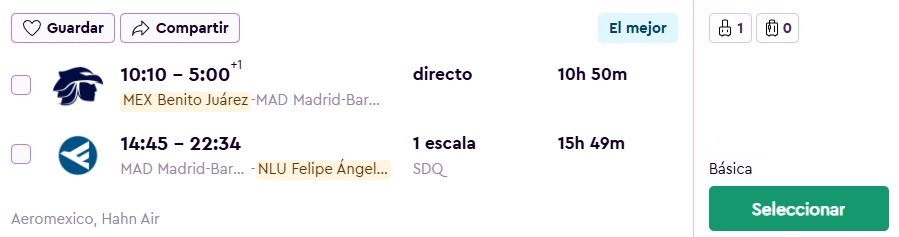
Option 1 (direct flight) states:
Departure: 10:10 PM – this is the local time in Mexico City (MEX).
Arrival: 5:00 AM the next day – this is local time in Madrid (MAD).
Duration: 10 hours and 50 minutes.
This means that although the flight lasts almost 11 hours, you land at 5:00 AM Madrid time. Remember that Madrid is 7 or 8 hours ahead of Mexico, depending on the season.
Keep this in mind to avoid booking accommodations or transfers incorrectly.
Change the time on your devices once you arrive and align your schedule with the new time zone. This will help you adapt faster and make the most of your stay.
To make the transition more bearable, we recommend you:
Go to bed and eat a little later than usual days before your flight. This way, your body will start to align with Madrid time.
Move to the rhythm of Spanish time, even if your body doesn't feel ready yet.
Upon arrival, go for a walk or stay outdoors to help your body adapt faster.
Avoid checking the time in Mexico, since it will only lengthen the adaptation process.
And remember that feeling tired or having temporary confusion is normal. So, be patient, don't get frustrated if the change doesn't feel immediate.
Daylight saving time in Mexico still applies in Baja California and other border municipalities, where:
It begins the second Sunday of March.
It ends the first Sunday of November, in sync with the United States.
Meanwhile, in Spain (peninsula and Canary Islands), daylight saving time:
Starts the last Sunday of March (at 2:00 AM, clocks go forward one hour).
Ends the last Sunday of October (at 3:00 AM, clocks go back one hour).
In 2027, Spain moves its clocks forward on March 28 and back on October 31.
How does this help when planning your trip?
This kind of information will help you:
Know when to adjust your watch.
Avoid arriving too early at the airport or missing connections due to confusion.
Look for flexible options on platforms like Skyscanner.
Organize transfers, check-ins, and activities without mistakes.
While Mexico and Spain share the same seasons, the weather can differ significantly. So it’s also wise to pack your clothes based on the forecast. For example, winter in Madrid may require a coat, while Mexico City is milder.
Check the weather forecast before making your packing checklist.
To pay in Spain, ARQ offers a card: a secured credit card backed by the balance in your ARQ account, accepted wherever Mastercard is.
It’s 5:00 AM in Mexico City in the European winter and 4:00 AM in the European summer.
It’s 11:00 PM in Madrid in the European winter and midnight in the European summer.
Yes. The Canary Islands are one hour behind Madrid.

Convert pesos to digital dollars or digital euros in seconds, at real market rates. Without hidden fees.
How to set up ChatGPT as an English tutor, a 7-day plan with a copy-ready prompt for each day, and what it can and cannot do for you.

Do you know the 7 Wonders of the Modern World? Discover which they are, where they are, and how they differ from the Wonders of the Ancient World.

American candies cross borders, especially the most popular ones. But where can you buy American candy? Enter and find out.
Scan the code and join ARQ.
2 million people around the world already manage their finances with ARQ.